(Last Updated on November 4, 2026 by Henry)

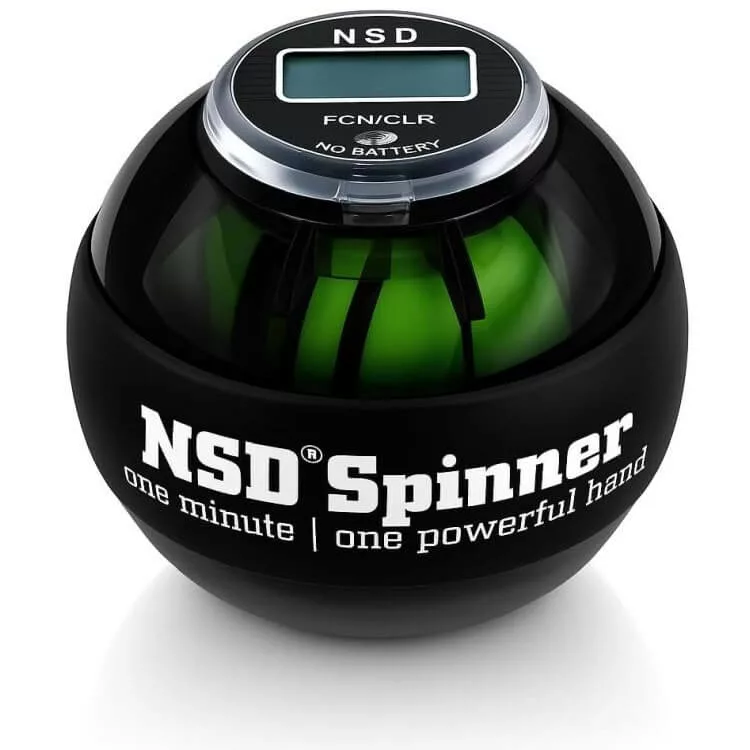
  • Name: NSD Spinner Gyro Ball with Counter
  • Category: Wrist Torque Training
  • Purpose: Wrist, forearm, and grip conditioning
  • Rating: 4.4 / 5
  • Availability: Amazon

Check Price on Amazon

  • Thumb-Wind Auto-Start: Spring-loaded starting mechanism eliminates the need for a pull cord or battery.
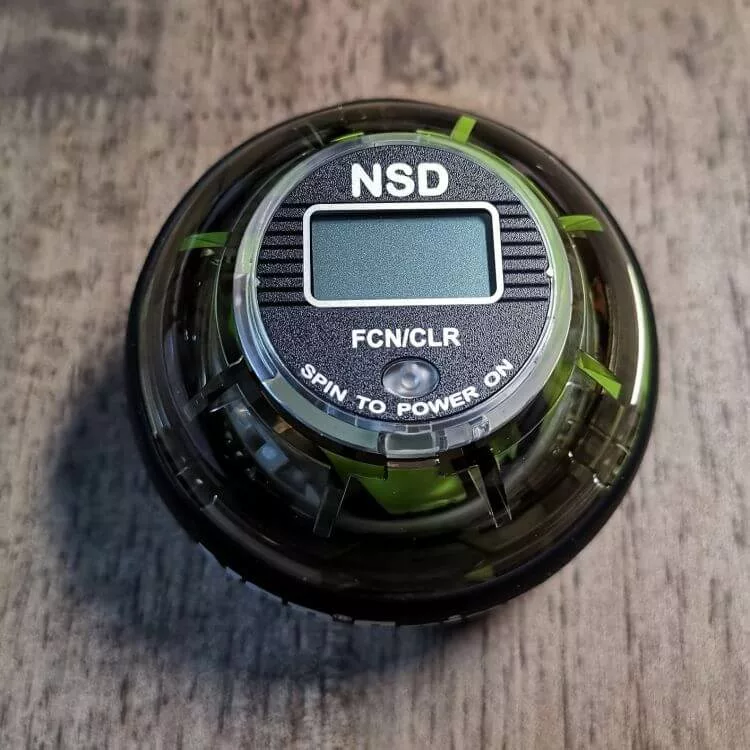
  • Digital Performance Counter: Built-in LCD tracks RPM and provides measurable performance feedback.
  • Gyroscopic Resistance: Rotational speed increases the training demand on the wrist and forearm.
Got Strong Fingers But Wrists Flailing in the Wind?
Learn How to Build Strength Through Wrist Flexion & Extension

✋ Overview: What Problem Does NSD Spinner Gyro Ball with Digital LCD Counter Solve?

Gyroscopic Resistance That Builds With Your Movement

The NSD Spinner takes a different approach to grip training. Instead of squeezing a spring or holding a weight, you control a spinning rotor through circular wrist movements. As the rotor accelerates, the gyroscopic forces create a growing challenge for the muscles working to control the movement.

What stands out to me is the relationship between movement and resistance. You aren’t simply selecting a fixed load and repeating the same motion. You must maintain a smooth wrist action while controlling a spinning mechanism that becomes more demanding as its speed increases. That gives this tool a distinct place in a grip-training setup, particularly for people interested in wrist torque, forearm conditioning, and rotational control.

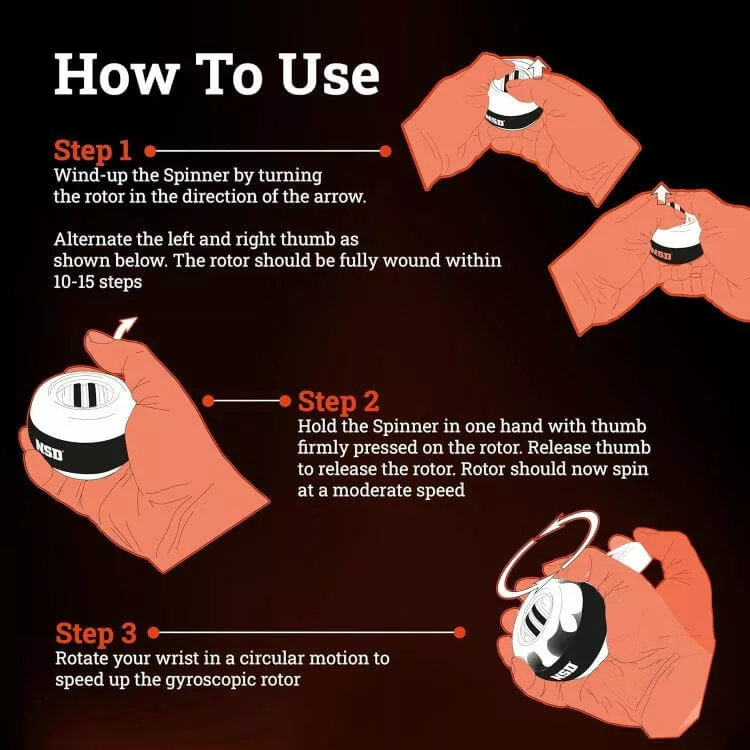
The thumb-wind starting system is another important feature. You rotate the internal rotor using your thumbs, release it, and begin the circular wrist movement. This removes the need for a separate starting cord and makes the setup more self-contained. The technique still takes some practice, but the mechanism is designed to make getting started easier.

The built-in LCD counter adds a performance element. You can monitor spinning speed rather than relying entirely on how the movement feels. For someone who enjoys tracking progress, this provides a concrete target to work toward. However, RPM is a performance measurement, not a direct measurement of grip strength or a guarantee of muscular progress.

I’d view the NSD Spinner as a specialized complement to conventional grip exercises. It offers a different resistance profile and movement pattern, but it doesn’t replace heavy grippers, loaded carries, or dedicated wrist-flexion and extension exercises when those are the primary training goals.

⚖️ Pros & Cons: NSD Spinner Gyro Ball with Digital LCD Counter

A Convenient Start, Measurable Performance & Specialized Resistance

Pros:

  • Cord-free starting: The thumb-wind mechanism removes the need to carry or replace a starting string.
  • Progressive rotational challenge: Spinning faster increases the gyroscopic demand, allowing effort to change during use.
  • Built-in LCD counter: Provides RPM feedback and makes performance tracking part of the workout.
  • Compact and portable: The handheld design makes it easy to keep nearby for short conditioning sessions.
  • Durable-material design: The plastic housing, zinc rotor, and stainless-steel axle provide a purposeful construction for repeated use.
Cons:

  • Learning curve: Starting the rotor and maintaining a smooth, controlled motion may take practice.
  • Limited training specificity: Gyroscopic rotation does not replace dedicated crushing, pinching, or heavy wrist-strength exercises.
  • Mechanical and display concerns: The internal starting mechanism and LCD introduce components that may malfunction and affect long-term value.

Still Deciding?
See How It Stacks Up Against Similar Wrist Torque Trainers

Get it on Amazon See a Cheaper Alternative

NSD Spinner Gyro Ball with Digital LCD Counter: Ranking 84 out of 100

🎯 Who Should Use NSD Spinner Gyro Ball with Digital LCD Counter?

For Athletes, Climbers & Anyone Training Wrist Control

  • Climbers and grip enthusiasts: Adds rotational forearm conditioning alongside hanging, pinching, and crushing work.
  • Racket-sport and combat-sport athletes: Offers a different way to train wrist and forearm control, provided it complements rather than replaces sport-specific training.
  • Musicians and precision-focused users: Provides a compact tool for controlled wrist movement and forearm conditioning outside their main activity.
  • Experienced home trainers: Suits people who want a portable, measurable exercise and are willing to learn its starting technique.

🧩My Rating Summary

  • Build Quality: 4.3 / 5 The plastic housing is paired with a zinc rotor and stainless-steel axle, giving the device a more substantial internal construction than a simple plastic exercise ball. The enclosed mechanism and digital counter still make long-term reliability important.
  • Ease of Use: 4.1 / 5 The thumb-wind mechanism is more convenient than a separate pull cord, and the counter makes the device easier to monitor. Learning to start the rotor and maintain a controlled rhythm may take some practice.
  • Comfort: 4.2 / 5 The compact handheld format makes the spinner practical to hold during short sessions. Comfort and control will depend on hand size, grip security, and the effort required to maintain the rotation.
  • Resistance Quality: 4.5 / 5 Gyroscopic resistance increases with rotational speed, creating a distinctive challenge for wrist and forearm control. The resistance is less directly measurable and less standardized than a fixed-load exercise.
  • Progression Potential: 4.4 / 5 The LCD counter provides a clear performance target, while increased rotational speed creates a greater challenge. RPM improvements are useful feedback, but they should be paired with good technique rather than pursued at any cost.
  • Value for Money: 4.2 / 5 The self-start mechanism and digital counter make this a more feature-rich option than a basic gyro ball. Its value depends on how much you will use the tracking features and whether gyroscopic training fills a genuine gap in your routine.

⚙️Technical Details

  • Brand: NSD
  • Manufacturer: NSD
  • Model: PB-188AC Black (listing model designation)
  • Product Type: Gyroscopic wrist and forearm exerciser
  • Material: Plastic housing, zinc rotor, stainless-steel axle
  • Color: Black
  • Weight: 9.2 oz / approximately 261 g
  • Dimensions: 5.2 × 4.6 in
  • Starting Mechanism: Thumb-wind, spring-loaded auto-start
  • Display: Battery-free LCD digital counter
  • Maximum Advertised Speed: Up to 18,000 RPM
  • Advertised Torque: Up to 24.9 lb-in
  • Power Source: No battery required for operation
  • Included Components: Gyroscopic spinner with LCD counter
  • Primary Training Focus: Wrist torque, forearm conditioning, and rotational control
📈 Where NSD Spinner Gyro Ball with Digital LCD Counter Fits In Grip Strength Progression

📈 Where NSD Spinner Gyro Ball with Digital LCD Counter Fits In Grip Strength Progression

Short Sessions, Rotational Work & Measurable Targets

As a forearm-conditioning accessory: The spinner adds a movement pattern that differs from grippers, wrist curls, and loaded carries. It can help diversify a routine without requiring a large amount of equipment.

For climbers and grip athletes: It may complement more specific grip work by introducing dynamic wrist and forearm engagement. It should remain supplementary to climbing practice, hangs, pinch work, and other targeted exercises.

For performance tracking: The LCD provides a simple way to monitor RPM and set personal goals. Focus on consistent, controlled movement rather than trying to achieve a record every session.

During short breaks: The compact design makes the spinner convenient for brief exercise sessions. Keep the effort moderate if you are using it between other activities rather than treating every session as an intense workout.

When rebuilding exercise capacity: The spinner may have a place in a professionally guided program when the movement and resistance are appropriate. It should not automatically be considered suitable for every wrist injury or repetitive-strain condition.

The best role for this tool is a specific one: rotational conditioning that complements the rest of your training. It becomes less useful if it displaces the foundational exercises that directly address your main grip or wrist-strength goal.

💪 Training Benefits & Strength Transfer Potential

💪 Training Benefits & Strength Transfer Potential

Resistance That Responds to Rotational Speed

The NSD Spinner’s defining feature is the way its resistance develops during movement. A conventional wrist curl uses an external load, while a gripper provides resistance against finger closure. This device instead uses a rotating mass to create gyroscopic forces that you must control through wrist movement.

As the rotor spins faster, maintaining the motion becomes more demanding. That creates a useful opportunity to train repeated wrist movement, forearm engagement, and control under a changing rotational load. The challenge comes from keeping the movement smooth and coordinated rather than simply forcing the wrist through a large range of motion.

I see the greatest value here in rotational conditioning and muscular endurance. The spinner can complement exercises that train crushing grip, support grip, and wrist flexion or extension, especially if your routine currently lacks this kind of dynamic movement.

The digital counter can help you monitor whether you are maintaining or increasing your spinning speed. That said, higher RPM alone should not be treated as proof of stronger wrists. Your results will depend on consistency, technique, training frequency, and how the spinner fits into the rest of your program.

The advertised torque figure also needs context. It is a manufacturer-provided maximum, not a fixed resistance that you experience throughout every repetition. The actual demand changes with rotor speed and how you control the movement.

For that reason, I’d start with smooth, controlled rotations and build speed gradually. Chasing the highest possible RPM from the beginning misses the point of a tool that depends on coordination and sustained control.

Want to Understand Wrist Torque Better?
Explore the Wrist Movements Behind More Capable Wrists

🧠 Performance & Feel During Training

🧠 Performance & Feel During Training

A Compact Trainer With a Technique-Based Learning Curve

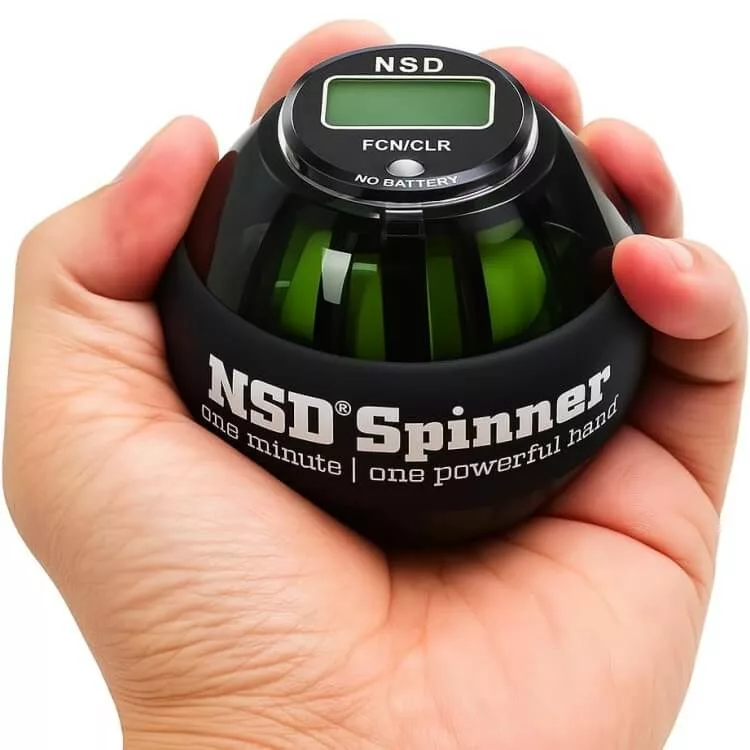
The NSD Spinner is small enough to hold in one hand, and its thumb-wind mechanism keeps the starting process contained within the device. You do not need to attach a cord or find a separate power source, which makes it convenient for quick sessions at home, at work, or between training activities.

The main adjustment is learning how to use it. After winding the rotor and releasing it, you need to move your wrist in controlled circular motions to maintain and increase the spin. Rushing or using excessive movement from the elbow and shoulder can make the exercise less controlled.

I would treat the first few sessions as technique practice rather than a speed test. Start slowly, keep the motion comfortable, and allow yourself time to coordinate the movement before attempting higher speeds. The counter is useful for feedback, but it shouldn’t distract you from how your wrist feels.

Grip security also matters. The device needs to remain firmly held without requiring excessive squeezing. If your hand becomes tired, your grip starts slipping, or the movement causes discomfort, reduce the effort or stop the session.

The compact design is a genuine practical advantage, but this is not a completely effortless exercise gadget. Its best use comes from learning a repeatable movement and applying it consistently.

🏗 Build Quality & Long-Term Durability

🏗 Build Quality & Long-Term Durability

A Robust Internal Design With Moving Parts to Consider

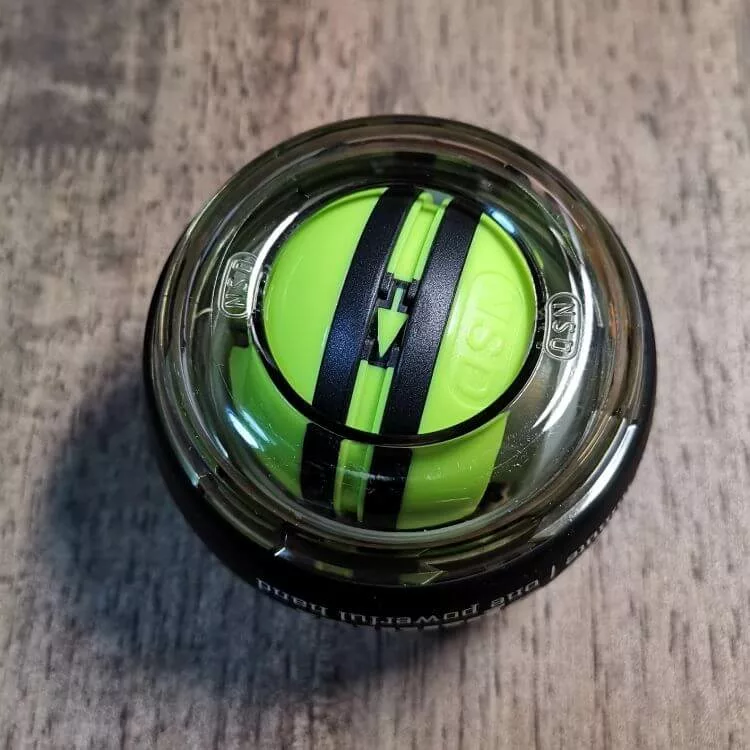
The NSD Spinner combines a plastic outer shell with a zinc rotor and stainless-steel axle. These components give the device a defined mechanical structure, and the enclosed gyroscopic mechanism allows the rotor to operate without an external cord or battery.

The design is intended for repeated use, but the quality of the materials alone cannot guarantee long-term reliability. The spring-loaded starting mechanism is essential to getting the rotor moving, while the LCD counter adds another component that can fail independently of the spinning mechanism.

I would pay attention to whether the rotor starts consistently, whether the ball runs smoothly, and whether any unusual rattling or vibration develops. A device that becomes difficult to start or behaves inconsistently is less useful as a training tool, regardless of its maximum advertised speed.

The outer housing also deserves sensible handling. Although the product is marketed as durable, I wouldn’t assume it is immune to impact damage or that dropping it repeatedly will have no effect on the internal mechanism.

The display is a helpful feature, but it isn’t essential to the basic training function. If performance tracking matters to you, the counter adds value; if your main goal is simply rotational conditioning, the reliability of the spinning mechanism should take priority.

Overall, the NSD Spinner has a purposeful construction for a compact mechanical trainer. Its long-term value depends on the reliability of both the rotor mechanism and the features that distinguish this model from simpler alternatives.

🏠 Everyday Usability & Practicality

🏠 Everyday Usability & Practicality

A Cord-Free Workout You Can Keep Close

The spinner’s portability is one of its most attractive features. It fits into a small training kit or desk drawer, requires no battery, and can be started without a separate cord. That removes several small inconveniences that can discourage people from using equipment consistently.

The built-in counter makes the device more engaging for people who enjoy measurable goals. You can monitor speed and work toward improving your performance over time, although the screen may be difficult to read while the ball is moving continuously in your hand.

There is a small but important distinction between convenience and accessibility. The thumb-wind system simplifies starting, but people with limited thumb function, significant hand pain, or reduced coordination may still find the winding action challenging. It is worth considering whether you can operate the mechanism comfortably before making it part of a routine.

The spinner also requires no special setup space, making it easy to use for short sessions. Still, its movement is active rather than passive: you must remain engaged with the wrist motion to maintain the spin.

For someone who enjoys compact training tools and likes tracking performance, this format has clear everyday appeal. For someone who wants a simple fixed-resistance exercise, a conventional gripper or light wrist tool may be more straightforward.

✅ Final Verdict: Is NSD Spinner Gyro Ball with Digital LCD Counter Worth It?

A Premium Gyro Ball for People Who Want More Than Squeezing

The NSD Spinner stands out because it combines a thumb-wind starting mechanism, a built-in digital counter, and gyroscopic resistance in one compact trainer. It offers a distinct way to challenge the wrist and forearm, and the RPM display gives performance-focused users something concrete to track.

I see it as most valuable for people who already understand the basics of grip training and want to add rotational conditioning. Climbers, athletes, musicians, and dedicated home trainers may appreciate having a tool that challenges control and endurance differently from conventional grippers or wrist curls.

The limitations are worth keeping in mind. The starting technique takes practice, the LCD is a performance aid rather than a necessity, and the device does not replace exercises that target crushing grip, pinching strength, or heavy wrist loading. The manufacturer’s rehabilitation claims should also be treated cautiously; a gyro ball is not a universal treatment for wrist pain, carpal tunnel syndrome, or tendinitis.

Its value ultimately depends on whether you will use the distinctive training method. If you want a measurable, portable forearm accessory and enjoy working toward performance targets, the NSD Spinner is a compelling option. If you simply want to build maximum crushing strength, your money may be better directed toward a suitable gripper or another more specific training tool.

A strong candidate for a premium wrist-torque training setup, particularly for users who value cord-free starting and digital performance feedback. Think of it as a specialized addition to a balanced grip routine, not a replacement for one.

Thanks for Checking It Out!

Have You Trained With NSD Spinner Gyro Ball Before?
Share Your Experience in the Comments!

Wrist Pain? Learn How KT Supports Tendons in The Hand & Wrist
& Check Out the Grip Training FAQ for Quick Answers.

Need to Improve Your Grip? I'm Here to Help. As a fitness enthusiast, I explore grip strength, hand training, performance, injury prevention, & recovery to help you train smarter. Whether you're chasing a competitive edge, getting back from an injury, or simply looking for better ways to use & strengthen your hands, you'll find practical ideas & useful tools right here.

Leave a Reply

Your email address will not be published. Required fields are marked *